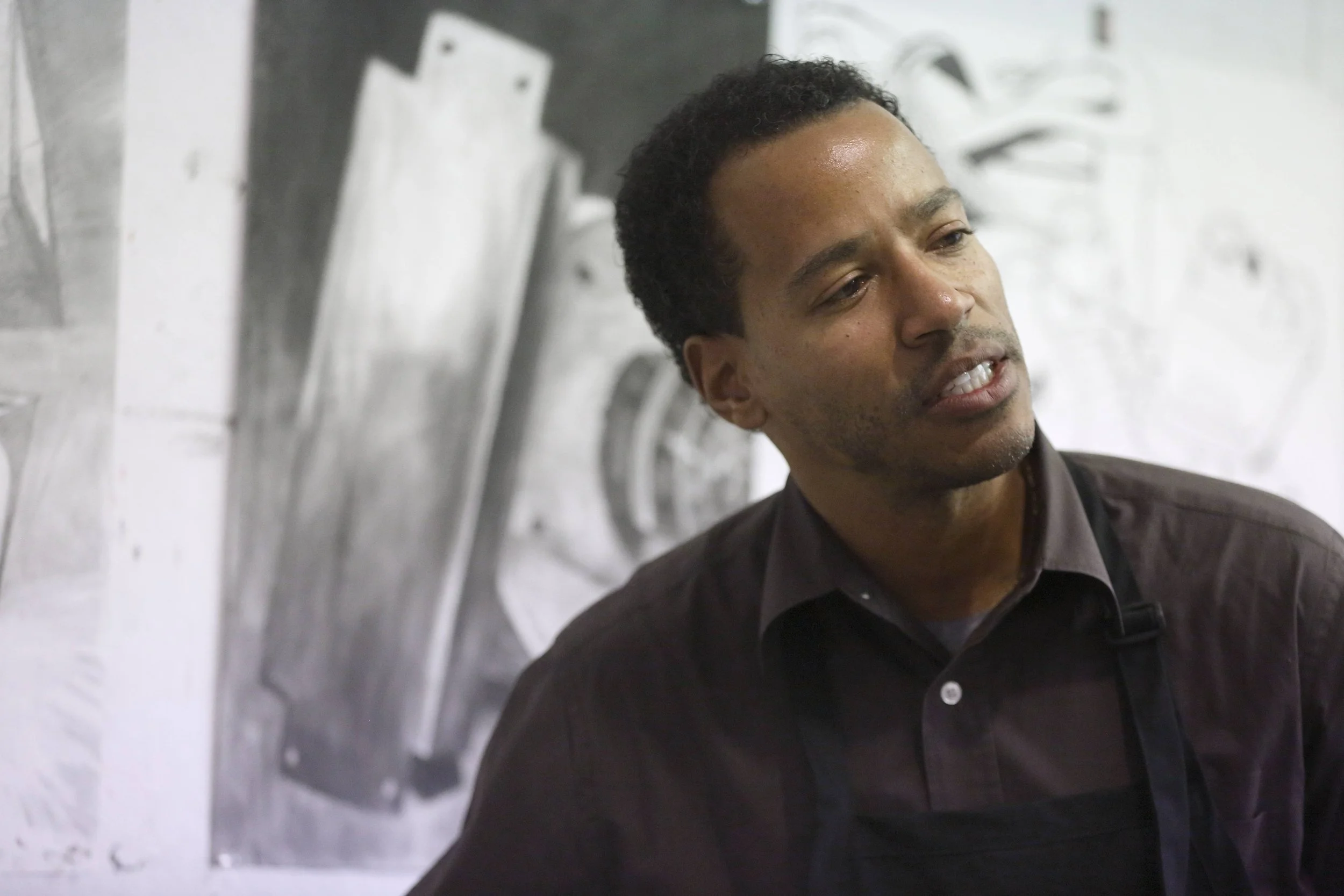
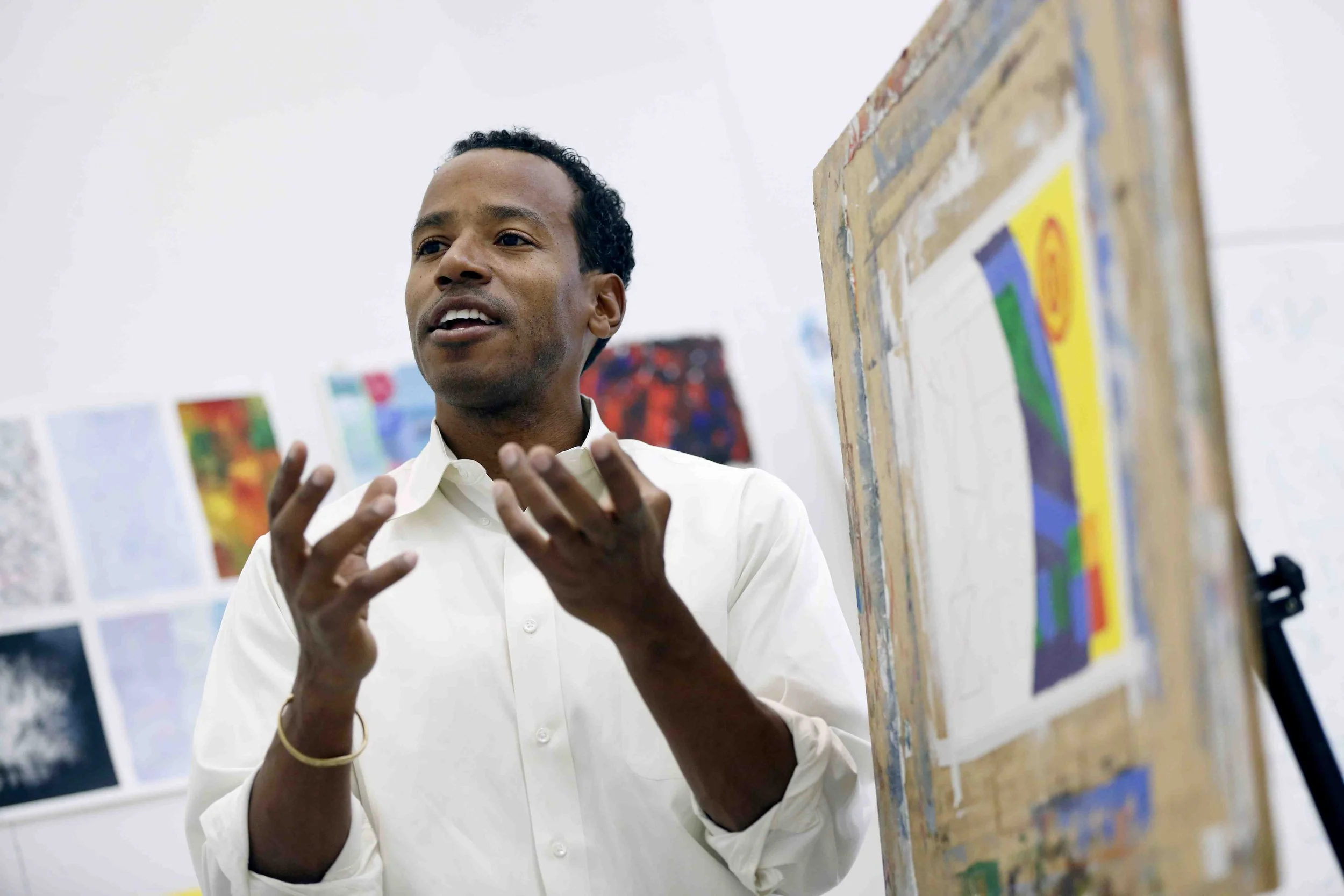
About David H. Roane
-
Mr. Roane is currently married to an awesome wife with whom he has two kids, a daughter and a son. He grew up in the Greater Boston area within a family that included two brothers, one of whom is his identical twin. Currently, Mr. Roane teaches art at Noble & Greenough School, a small private school located just south of Boston, Massachusetts. Mr. Roane graduated from Princeton University with a B.A. in English, and he did his graduate studio work at The School of the Art Institute of Chicago and at The University of Chicago, where he pursued his MFA in Painting and Drawing.
Mr. Roane’s career as an artist who writes, paints and teaches, stretches across two decades. His art is displayed in private residences, corporate offices such as those of the Liquitex Corporation, and at various institutions including his alma mater, Princeton University. Images of his work have been featured in such national publications as Art in America and Studio Visit Magazine.
Closely related to Mr. Roane’s visual work is his written work, which has earned publication in various news outlets such as The New York Times, The Boston Globe, and Boston’s Bay State Banner, as well as in scholarly journals such as
The Journal of African-American Studies. Topics range from issues concerning race and education to those associated with the arts.Before returning to Massachusetts to teach, Mr. Roane lived in the Washington DC area, where he served on the Alexandria Commission for the Arts. Currently, his board membership includes participation on the Educator’s Advisory Board of the Boston Museum of Fine Arts and the board of the Henry Buckner Elementary School, located in Cambridge, MA. Mr. Roane values board service for the opportunity to effect art as a resource that empowers both the community and the individual.
While living in Virginia, Mr. Roane taught at a public charter school in Washington, DC and as an adjunct professor at the University of the District of Columbia. Throughout his tenure at Noble & Greenough School, the quality of Mr. Roane’s teaching has been consistently recognized, as when he was selected by the Class of 2008 to give the Commencement Day address, and by the Class of 1999 for its yearbook dedication. As a craft that allows him to remain accountable to the larger world, teaching is how Mr. Roane’s own art performs its social function.
Mr. Roane’s teaching experience now extends across the continuum lying between public and private systems, urban and suburban demographics, secondary and higher ed. This range of teaching experiences consummates the pursuit of Mr. Roane’s ultimate goal—to promote art as a self-empowering tool for the creation and communication of meaning.
Mr. Roane’s only other pursuit in life remains the rare sighting of a wondrous and beautiful flower.
-
I believe that, on a fundamental level, all art is autobiographical in nature. My own story starts in the womb, or, more specifically, at what my mom refers to as “The Twelfth Hour”—the exact moment when, according to her, she felt the egg in her belly split into two. My own attempt at creating narrative meaning could have started for me then—at the instant when the arrival of another person—my twin brother—announced the existence of some-thing beyond my body and so, a world that could serve as the object of my perceptions.
At 2:54 in the morning some 50 years ago, and 12 hours after my mom and dad did “The Act,” I came into being—a being which declared my separation from the world at the same time I was entering the world—an existence for which fracture, itself, would serve as the basis for my consciousness. From then on, my life would be a creative journey that would have me explore this paradox, as I attempted, in the form of a constructed narrative, to recover the wholeness I feel to have lost at the very instant of my becoming.
Since memory serves a narrative function for me, I believe I can claim my story mainly through the process of claiming my memories. This speaks of my insistence on the power of my own personal material—my own thorough sense of local life, literally from its conception—to effect elements of place, voice, etc.
Art simply becomes a way of representing and communicating this story. My artistic goal is to create patterns of meaning from my personal history, and then communicate that meaning via a linguistic system of painted images.
The memories themselves, or actually the representations of those memories constitute the linguistic system. The images are really symbols within a burgeoning network of ideograms. My pursuit of such seamless narrative continuity betrays my existential desire for wholeness, and, ultimately, for a healing of the breach caused by my necessarily being born a fragment.
Significantly enough, the desire to have my story communicate at all and extend beyond selfhood stems from an overarching sense of accountability I feel as one who exists merely as a fragment of the larger world around me. I believe that only a strict reliance upon the experience of my own felt-life can yield the specificity necessary for transmitting a tangible human experience—and so, an experience that can resonate in a universal way for others.
-
David H. Roane
22 Checkerberry Lane, Framingham, MA 01702 tel: 703-863-8106 email: dhroane@gmail.com
Education
University of Chicago, Chicago, IL, June 2002
Master’s of Fine Arts, Concentration in Painting & Drawing
Honors: University of Chicago Fellowship
School of the Art Institute of Chicago, Chicago, IL, May 1995
Post-Baccalaureate Certificate in Painting & Drawing
Honors: SAIC Incentive Scholarship, SAIC Post-Baccalaureate Recognition Scholarship
Princeton University, Princeton, NJ, June 1994
Bachelor’s of Arts, English
Honors: Princeton University Women’s Organization Award for distinguished community service.
Member of the 1993 NCAA Final Four Men’s Soccer Team
Experience
Noble and Greenough School, Art Instructor
Dedham, MA (September 1995 – June 1999, June 2006-present)
One of the oldest New England prep schools in the region, Noble and Greenough School has developed a prestigious tradition of academic rigor and unsurpassed levels of student achievement and faculty excellence.
Received 1999 Yearbook dedication.
Selected as 2008 Commencement speaker.
Taught elective courses of Art History, African-American Literature, African-American History, Studio Painting, Studio Drawing;served as academic advisor to 10 students.
Founder of the Nice People’s Campaign, an organization designed to raise awareness around issues of how people treat one another.
As Co-Director of Multicultural Affairs, organized events to celebrate pluralism; recruited faculty and students of color; addressed programmatic needs of students, faculty, and parents; coordinated and moderated parent/student panel discussions; served as faculty advisor to the Multicultural Students’ Association and to the Multicultural Parents’ Association.
Supervised boys' dormitory.
Coached JV Boys’ Soccer Team, JV Girls’ Soccer Team, and JV Boys’ Basketball Team.
Friendship Edison Public Charter School, Teacher
Washington, DC (Winter 2004 – Spring 2006)
Friendship Edison Public Charter School sits on the edge of educational reform as a charter school of innovation for DC area youth. Serving a student population of nearly 1,300, it is the largest school in the District of Columbia, and sends over 90% of its graduating class to higher forms of education. My duties involve the following:
As a member of the school’s Re-Design Committee, assumed pivotal role in creating the Visual Arts Program and in re-structuring the school into separate career academies.
Brokered partnership with internationally renowned cultural institutions such as the Smithsonian’s Hirshhorn Museum and Sculpture Garden, the National Gallery of Art, and the National Museum of African Art. Relevant programming includes the development of a Hirshhorn Teen Advisory Committee, a docent internship program, and a Visiting Artist series.
Provided art instruction via studio survey courses and upper level courses in painting and drawing.
Served as faculty advisor for the Art Club..
University of the District of Columbia, Adjunct Professor
Washington, DC (Winter 2005 – Spring 2006)
Taught university art courses to Friendship Edison high school students enrolled in the Early College Program. In this program select high school students receive college credit through university courses.
City of Alexandria, VA; William Ramsay Recreation Center, Recreation Leader
Alexandria, VA (January 2003 – January 2004)
Based upon its city leadership role and innovative artistic programming, William Ramsay Recreation Center became part of a select cohort of local recreation centers licensed by the state. As a recreation leader my achievements included the following:
Instituted fine arts program—the first of its kind at the center—for youth ages 5-12.
Taught lessons in the basics of perception, design, and composition.
Worked with teens in developing Internet activities and fitness activities, and conducted faculty training workshops in the arts.
Administrative duties included the development and maintenance of registration and filing procedures to meet licensing requirements. This system was the first of its kind in the department and tracked roughly 170 children.
Renaissance Society, Gallery Assistant
Chicago, IL (September 2000 - July 2002)
Under the leadership of Suzanne Ghez, the Renaissance Society has developed an international reputation as a leader in the exhibition of contemporary art. While a gallery assistant, I provided the following services:
Oversaw the processing and billing of all catalogue orders and catalogue exchanges with leading art museums in the world; responsible for the inventory of all brochures and publications produced by the gallery.
Facilitated the creation of new organizational system for gallery storage and archives.
Created 30-page orientation packet for work-study students.
Assisted in overseeing gallery space and sale of editions.
Upward Bound, Teacher, Academic Coordinator
Boston, MA (summer 1998)
Upward Bound has received national recognition for its role in providing academic enrichment to youth from low-income backgrounds and to youth who are first-generation college attendees.
Instructed students in studio art and art history.
Coordinated all academic proceedings including overall course schedule and individual class and teaching schedules; advised students in an academic capacity.
Gallery 37, Instructor
Chicago, IL (summers of 1996, 1997)
Conceived by Maggie Daley, Gallery 37 is an award-winning summer job program in the arts for city of Chicago youth.
Selected as the representative teacher to speak during the 1996 Closing Ceremonies.
Represented The School of the Art Institute of Chicago as a Lead Artist.
Trained students in figure painting and still-life painting; oversaw the production of student work featured on NBC’s Today Show.
Related Experience
Board membership
Boston Museum of Fine Arts Educator’s Advisory Board (Sept. 2013-2020)
Henry Buckner School, Cambridge, MA (Sept. 2013-present)
Be Well Be Here (2021-2024)
Founder, Director, and Lead Instructor of The Print Academy, an arts mentorship program for youth, ages 13-19, based out of Roxbury, MA.
Alexandria Commission for the Arts (Alexandria, VA): Appointed to serve three-year term as city commissionerof the arts. Duties included grant distribution, budget management, and city-wide promotion of the arts. Helped oversee the distribution of over a quarter-million dollars in grant funding.
Delivered numerous presentations/speeches at the College Board National Forum, Noble and Greenough School (Dedham, MA), Lindley Cultural Center (Athens, OH) on topics concerning race, education, and art.
Conducted lectures and tours of various collections at the Boston Museum of Fine Arts for students of the Brooks School (MA), and the Upward Bound and Citizens Schools programs.
Facilitated youth and adult art workshops for the Smithsonian’s Hirshhorn Museum and Sculpture Garden, and The National Museum of African Art and for various Virginia-based organizations including the Alexandria Black History Museum.
Exhibitions & Shows
Framingham State University, Framingham, MA
2023 Noble and Greenough School, Dedham, MA
faculty show
2022 Black History Month
Noble and Greenough School, Dedham, MA
solo exhibit
2021 Lorem Ipsum
Noble and Greenough School, Dedham, MA
faculty show
2019 The Canvas is Not Neutral
Noble and Greenough School, Dedham, MA
faculty show
2017 Object, Image, Space
Noble and Greenough School, Dedham, MA
faculty show
2015 Pratt 108
Noble and Greenough School, Dedham, MA
faculty show
2013 Have Patience with Everything that Remains Unsolved in Your Heart
Noble and Greenough School, Dedham, MA
faculty show
2011 Noble and Greenough School, Dedham, MA
faculty show
2009 Noble and Greenough School, Dedham, MA
faculty show
Reflect Arts/Agni Gallery, NY
Small Works Show
2007 Noble and Greenough School, Dedham, MA
faculty show
Story
Lindley Cultural Center, Ohio University, Athens, OH
individual show
2002 Longing for Bunny Mercer, MFA Thesis Exhibition
Gallery 312, Chicago, IL
group show
2002 MFA Thesis Exhibition
The University of Chicago, Chicago, IL
individual show
1999 These Hands Are Ready to Cradle,
Noble and Greenough School, Dedham, MA
individual show
1996 American Council for the Arts, New York, NY
1995 Black Creativity 1995
Museum of Science and Industry, Chicago, IL
1995 Nippon U.S.A. / The School of the Art Institute of Chicago Presidential Awards
Competition
Nippon Steel Building, Chicago, IL
1995 Undergraduate Art Exhibition
The School of the Art Institute of Chicago, Chicago, IL
May 1993, May 1994, March 1995 Undergraduate Art Exhibitions
Princeton University, Princeton, NJ
1994 Public unveiling of mural, "Into The Clear"
Princeton University, Princeton, NJ
1993 Spring Arts Festival
Princeton University, Princeton, NJ
Publications, Reviews, Speeches
2026 Time is a Medium, Freeman Legacy Dinner, Noble & Greenough School.
Black History Month, Noble & Greenough School.
2015 “Why Are They Still Here?” Bay State Banner, Aug. 20.
2013 “School Choice and a Mayor’s Conundrum,” Bay State Banner, Dec. 19.
“Aid in the Escape from Ghettos—of Poverty and Privilege,” Boston Globe, Oct. 5.
“Anti-Bullying Laws Should Apply to Gangs,” Featured on Boston Public Radio, Jan. 25; 32:30.
2012 “Anti-Bullying Laws Should Apply to Gangs,” Bay State Banner, Oct. 3.
“Is Black History Month Still Necessary,” Bay State Banner, Feb. 22.
2011 “Dr. King’s Legacy from Different Angles, “ New York Times, Sept. 2.
“In My Own Backyard: A Different Take on Summits,” Bay State Banner, Oct. 26.
Studio Visit. Vol. 3. The Open Studios Press. 166-67.
2007 “U-Turn.” Cum Laude Magazine. 31-36.
2002 The Bunny Book
Published in conjunction with the exhibit, "Longing for Bunny Mercer."
The University of Chicago, Chicago, IL.
1995 Art in America, a premiere and leading international art publication.
F News Magazine, The School of the Art Institute of Chicago, Chicago, IL.
1994 The Daily Princetonian, Princeton University, Princeton, NJ.
Collections
Binney & Smith corporate headquarters, Philadelphia, PA
Princeton University, Princeton, NJ
Various private collections
-
The Roane Less Traveled
On identity, twinship, and the canvases in between
By Brynn Bryant
On a brisk fall evening, upon a quiet street in Wayland, Massachusetts, lined with soft trees and white-picket fences, a police cruiser slowed behind a car that had made the same turn dozens of times before. Inside the car were two college freshmen, home for a Thanksgiving break dinner, retracing a route so familiar it had become muscle memory. Same turns, same rhythm, same destination: a family friend's house. The kind of drive no one remembers because nothing has ever required remembrance. Until, suddenly, it did.
The cruiser stayed with them through each turn, implicating patients, and uninvitingly following them into the driveway. When the students stepped out, the office did as well. He looked between the young men and the house, as though waiting for the resolve into something more legible. “What are you doing here?” He asked.
It was a fair question, in the abstract. Less so in context, which included a driveway, a front door, and a lifetime of familiarity that apparently required permission. Everything about the area was known; the only thing unregistered as familiar was the presence of the two young men themselves. At that point, they weren’t students coming home for dinner anymore; they were something else entirely, people to be accounted for.
It took the arrival of their friend’s mother at the door to correct the equation. She explained, as calmly as one might explain the weather, that yes, they were expected, yes, they live in the area, and no, nothing unusual was happening. The officer left. The street returned to its earlier silence, the kind suggesting covering up a secret that was accidentally revealed. But something else remained. “Something kind of clicked,” David Roane would later say. “I was seen for being black. For all the wrong ways.”
In the art studio, Mr. Roane is known less for moments of harsh confrontation than for a kind of intentional stillness. Similarly, his space is bright, airy, and subtly alive. Bright studio lights are positioned next to displays, and hang overhead from a high ceiling, filtering across an oval array of wheeled wooden desks permanently decorated with blotches of paint, charcoal, and pencil from overly excited artists who extended their work off the paper. Blue easels stand nearby, paired with armless rolling stools that glide across a pearl marble floor, dribbled with dried oil paints, and the occasional runaway pencil, as if the room is slowly accumulating its own autobiography.
80s and 90s R&B music hums in the background, as students move freely and converse without urgency. Students in other classes come in during AP Studio Art periods to chat with friends, look at some art, or complete a mini arts and crafts project. It doesn’t feel like a classroom, as much as a place where people can come to have a shared, placid pause that happens to involve paint.
Along the walls, student work is pinned in careful sections. Drawings, collages, and half-finished ideas made public. Blue painters' tape and handwritten name tags impose order, creating a clear division between students and their artistic prowess. Along the furthest wall sits a heavy wooden cabinet wedged between two sinks, doing its best to contain the chaos of half-clean palettes, constant draws of tools that seem to migrate to a new home every week, and bundles of different paper mediums. Nothing is perfectly in its place all at the same time, but neither are we.
As far as I can remember, I was twelve the first time I walked up to the Second floor of Henderson and took a sharp left into the Henderson Arts Studio. There stood all five-foot-seven (and a half) of Mr.Ronae, vigorously scrubbing dried watercolor paint from his toffee-complexioned hands. His short brown curls were damp from stray sink water, and his smock bore the accumulated remains of his latest easel experiment, something involving abstract reflections and, judging from the floor around him, very little restraint.
He instinctively smiled, shook Oris’ hand, and welcomed me back to another T.G.I.F painting session. Like I did one Friday every month, I retreated to my usual back corner with paper and crayons and began to draw. Eventually, he arrived at what I had intended to be a self-portrait and what, in execution, resembles a witness sketch. He asked about school, basketball, and the twice-a-week art class that had recently become the center of my personality. Despite the disfigured face, Mr.Roane studied the painting with startling seriousness, as though he’d stumbled upon something small but promising retrospective in the MFA.
He studied the portrait with an intensity that felt disproportionate to the art’s quality but entirely proportionate to his character. “Focus on the creativity and individuality rather than the practicality of your work,” he said in the same mildly curious, even tone he still uses today. It was the kind of sentence that would be offensive coming from almost anyone else, but from David Roane, it inspired the kind of artist–and person–I wanted to be. Afterward, he sent his best regards and love to the family with complete sincerity and wandered off to his next easel venture. I grabbed a juice box and settled into the window-lined cove just outside and to the right of the studio, staring at the trees and rehearsing how I would later tell Oris that I now had a monthly art class with Mr.Roane–as though I had just secured representation at The Louvre.
Nothing about Roane's studio or teaching approach is intimidating. “The way he teaches is almost like the way he is an artist.” Says Mariah Oats, a friend and colleague of Roane. “He pays very close attention to detail, not just in your work, but in you as a person. He focuses on your truth and then helps you bring it out.” There is an expectation in the studio that you will try, always look closely, and that whatever you’re sustaining an investigation in, is only as interesting as your willingness to stay curious about it.
“Forty years ago, back in the 70's, when our family was living in Franklin, the town was indeed more rural and working-class, Italian. Roane's early years unfolded in Franklin, MA. The town has since grown both in terms of its commercial development and its demographic diversity,” he recalled, describing the cultural texture of the town. The town has changed into a more diverse and developed area, though he remembers the version defined by a certain uniformity.
At eight years old, his family moved to Wayland, his mother, Alexine Johnson Roane, seeking better educational opportunities. He and his family were one of only two black families in the area, aside from students bused in through the METCO program from neighborhoods like Dorchester, Mattapan, and Roxbury. Publicly, he was accepted. He played basketball and soccer, made friends, and moved easily through the social world of his peers. But acceptance, as he would come to understand it, did not always mean recognition. “Both white AND black kids equated being black with being urban. And we weren’t urban, so we weren't seen as really being black.”
Publicly, life was relatively easy. Privately, it was something else entirely. “It made our day-to-day life easier, publicly, because we were accepted. And yet, privately, very confusing because I identified as being black.” He wanted to be seen as Black. But no one–at least not in the way it mattered–would see him that way.
Roane frequently saunters around the Nobles campus, sporting jeans and a collared button-up, slightly rolled at the cuffs, a big smile overwhelming his smaller frame, emanating nothing but joy and positivity. Greeting everyone with a contagious happiness before indulging in his work. “I always try to greet everyone in a positive manner,” he told me, “you never know how a kind greeting and thoughtful conversation could change someone's day”.
Oris Bryant, a longtime friend and colleague of Roane, agrees: “David’s genuine care translates to how he asks his students how they are doing and if they have any 'questions, comments, concerns, inquiries, suggestions.' He is also always ready with a smile and a hug and is truly the 'nicest person' on the faculty.” Bryant himself often says, “I don’t have friends.” Yet, is still vulnerable to David Roane's contagious kindness (and even allowed a single brief hug during the AP art show).
Similarly, in class, Roane’s giddy gait does not falter as he passes beside each easel with thoughtful, unvarnished observations, offering words of encouragement, or words of motivational encouragement you’d find in Target’s home decor section. But Roane says it affirmatively, and without hesitation. He’s unmistakably affable when giving open and honest feedback to students. Provoking, though, and curiosity deepen students’ understanding of their own works. As a student of Roane’s, I can speak to the clear effort he makes to nurture a communicative, humble classroom, and the contagious joy that impacts me and six other young women, 3-4 days a week, even if it's only for an hour and 10 minutes.
Unfortunately,AP Art is not for the faint of heart, and whoever said it was tea and crumpets with a side of painting, lied. When I signed up for the full-year course, I did so under the impression I was entering a relaxing self-guided painting course, an easy A, for an easy senior spring. Within a week, the course was almost dropped, my impression collapsing under the weight of deadlines, self-doubt, and the unsettling realization that “self-guided” is just a polite way of saying you are alone with your own taste. Convinced I was not, in fact, AP material, and thinking my work had to be expositorily literal, the work stopped feeling like mine and started feeling like painted evidence in a case I was losing. It was around that point, between quitting and stubbornness, I was reminded–as if it were obvious all along, “your art is a unique composition of your innermost self. Your work is interpretive and particular to you; that is what makes it significant.”
He often says things like this, often enough that they come across as natural instruction rather than advice. Ending almost every class by telling us to“always always be our quintessential self, and never ever apologize for it.” In a quiet finality, as if the matter has already been settled somewhere higher up. Addy Keaveny, another student in Mr.Roane's AP class, recalls, “I didn’t think I was going to make it; it was more work than I anticipated, and I genuinely couldn’t do it anymore. But he connects with us in such a special way, and it shows how invested a teacher he is. He doesn’t just teach, he pulls you into the art world, like it's personal. Like his disappointment from you quitting, it would be like him seeing you quit on yourself.” Attested to by many of Roane's AP artists, he just has a way of making you feel like staying the course isn’t just about finishing the assignments, but about becoming someone you don’t want to walk away from halfway through. And so I (and I'm sure some others) didn’t drop the class. I have completed a 15-piece portfolio, have three pieces in the AP Art show this year, and–more surprisingly– reassembled a type of confidence I had previously assumed was either temporary or optional.
He began as a Teaching Fellow at Nobles in 1995. In his 25-year teaching tenure at Nobles, and in addition to his work in Drawing and Painting I and II, and AP Studio Art. Mr.Roane served as a Boys’ 3rd’s and JV soccer coach for four years, is still an active member of the DEI department, and acts as an advisor to countless students. He was selected by the class of 2008 to deliver the Commencement Day address, has a 99’ yearbook dedication, and has recognizable artworks in publications ranging from The New York Times to The Boston Globe.
But when asked what he is most proud of, his answer was simple. “My children, my marriage, and my artwork”. Although I'm not frequently visited by his son, Sahvan, I’ve had the pleasure of meeting his daughter, Sanaya, on many occasions. Ranging from lunch to helping me construct a mechanical engineering project. I can confidently say that her kindness, creativity, and eagerness to learn are clear reflections of what Mr.Roane has poured into her as a father and a role model. Mariah Oats observes, “he's the most patient man I've ever met. The way he pays attention at home is the same way he does at work. He makes sure his attention is where it needs to be. He puts his family first and always tries to find ways to spend time with them, keep things meaningful.” Roane and his wife met while teaching in a Washington, DC public charter school. “She was teaching math through Teach For America; he was teaching art during what he calls, with careful understatement, “the space between my two separate stints at Nobles.”
As a child, Roane wanted to be an engineer, following his father. “I thought engineers built things people could actually use,” he says, still mildly impressed by the logic. Summers were spent with his twin brother traveling the region, working basketball camps as coaches and administrators. “We mostly moved from gym to gym,” he says. “Structure, repetition, travel. It made sense at the time.”
When asked how life has compared to what he once imagined, he pauses. In college, he says, he loved the universe—and, rather naively, believed it returned the sentiment. “Fast forward thirty years,” he says, “and I think life—at least the authentic kind—is what you make of it.” He does not define “authentic.” It doesn’t seem necessary. If asked to describe himself in one word, he offers “tough.” Then correct it before it settles. “Mentally tough. Resilient.”
His friends, he suspects, would choose differently. “Earnest,” he says, without hesitation, the kind of word that sounds like it belongs in a report card written in pencil. There are regrets, though he handles them with the caution of someone uninterested in spectacle. In talking to Roane, the sun shining with the promise of a new day through the Henderson glass, Roane’s wishes came about. One of which, contradictively, was “appreciate more while it was happening, rather than only afterward, when it had already been reassigned as wisdom.”
The life obstacles are familiar in outline but personal in texture: being underestimated because he is small in stature and smiles easily; and, on another axis entirely, being Black in a predominantly white world where identity was often assigned before it was understood.
“The twinship”, he adds, complicates the question of identity in ways that are not immediately visible. Roane's identical twin brother, Jamie Roane, was inseparable growing up, “in a way that seemed to blur the boundary between self and other.” Roane explained, “When you think about being an identical twin, it’s like you standing up and splitting in half, and all of a sudden, there are two of you. That premise really governs a lot of how I see life,” he said. “It’s on a subconscious level, it drives most of my existence.” This sense of shared identity offered both grounding and complication. If identity is a negotiation between how one is seen by others, twinship adds another dimension: how one is reflected in another version of self. For Mr.Roane, this meant that questions of identity, race, belonging, and perception were never entirely solitary.
“The relation with my twin brother is something that is part of my psyche, part of my existence.” They were experienced, in tandem. Comparatively, Mr. Roanes' eldest brother similarly shared a different grapple with identity. Detected early and underdiagnosed, the eldest brother struggled with a learning disability, which led to a difficult social life, “at a time when neurodiversity wasn’t really considered,” Roane sighed.
And his mother, a writer herself, who “exposed my brothers and me to art and writing, introduced him to Drawing on the Right Side of the Brain. “That book was my Bible,” he says. “For understanding perception”, and navigating a world in which perception could reveal and obscure truth. If there is a single lesson he returns to more than any other, it is resilience.
However, if there is another life, free of unresolved complications, he sometimes allows himself to imagine what it would be like, which is not modest. “A Premier League soccer player. A world-class singer-performer. A neurosurgeon.” He offers the list unironically, as if unwilling to concede that talent might be required to specialize. Each ambition is delivered with the assurance of someone describing different versions of the same outcome. His walk-out song, if anyone ever required one, is “Above the Clouds” by Gang Starr–a melodic reminder of imagining an inevitable elevation, whether on a free kick, a stage, an operating table, or an easel.
The police stop during his freshman year of college marked a turning point, crystallizing his unresolved issues. He ponders, “Being subjected to a racist incident that made your public life uncomfortable, and yet, privately, it sort of settled me a little bit.” The experience was undeniably traumatic, and yet, it provided a kind of confirmation. “I had been affirmed to confirm something that I needed, I was to be seen as black. He then described the incident as increasing his “racial bona fides,” giving him a narrative that connected him more clearly to other black students throughout college whose experiences aligned more closely with conventional expectations.
After graduating from Princeton University with a Bachelor of Arts, Roane pursued graduate studio work at the School of the Art Institute of Chicago and the University of Chicago, earning a Master's in Fine Arts in Painting and Drawing. From there, his work took him through various roles–serving on the Alexandria Commission for the Arts in Virginia, teaching in Washington D.C., and eventually returning to Nobles, where he has remained for twenty-five years in various roles: teacher, coach, advisor, and presence. His artistic and intellectual pursuits were extensions of his personal history. The question of how we see, and how we are seen, remained central.
Attempting to capture color as form, not atmosphere, not symbolism, but something almost physical–to a non-professional artist (me) – sounds like the kind of artistic ambition destined to fail elegantly. However, looking at Roane’s pieces, like Color as Form:Biomorphacid, oil on canvas (2014), makes this assumption seem absurd. His gallery, an array of seemingly effortless paintings unfolding like a half-remembered thought. Resembles unfolding thoughts, often resisting immediate clarity. Saturated yellows, bruised reds, and brilliant blues brushed over one another with the uneasy logic of memory, forming an unsolvable puzzle. The work resists the increasingly popular demand that art come pre-interpreted instead of inviting the viewer to assemble the meaning from emotion, instinct, and personal association. After an immersive dive into his online exhibition and inquiring about his work, writing about his craft seems slightly futile, which appears to be part of the point. Roane describes his work as “a visual language where images function like words, accumulating into narratives that remain intimate, ambiguous, and unresolved.” Even the gallery as a whole carries that same feeling: a series of internal monologues suspended on walls, seducing the viewer to make sense of them. Although Roane “doesn’t get around to painting as much as I used to, between being a full-time parent and teaching. It’s something I would like to make room to do more of, again.”
As I sat across from Mr.Roane, the sun was still rising, his brows slightly furrowing. I inquired about the deeply pondering look that had washed over his face. He simply smiled and said, “Oh no, these questions just have me thinking deeply and reflecting in a way I haven’t in a long time.” I stood up and fussed with my curls, and thanked Mr.Roane for his time as I started heading towards my next period class. I stopped just atop the Henderson stairs to ask, “Mr. Roane, being the man you are, what is the driving philosophy or motto that holds all of this [you] together, he answers without ceremony.
Aside from “Many tiny drops make a mighty ocean,” and that only “you make your place in the world by making part of the world.”
His only other pursuit in life, “remains the rare sighting of a wondrous and beautiful flower.”